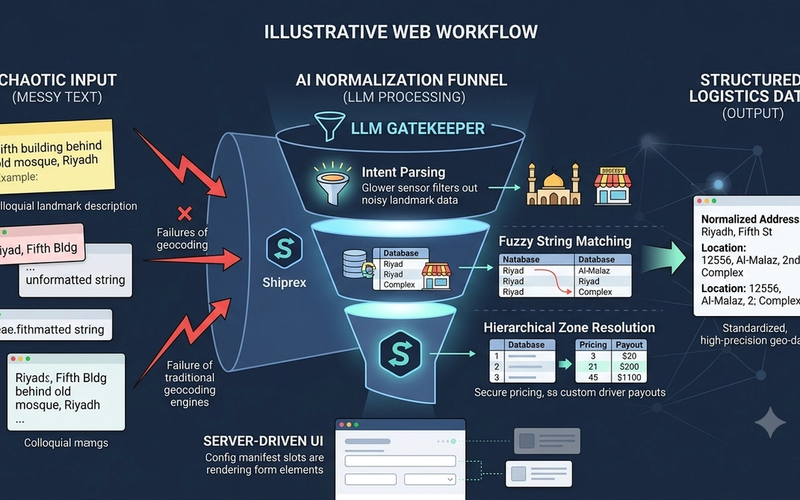
The Cost of a Typo: How AI Name Normalization Solves Last-Mile Address Failures
Misspelled cities and unstructured landmarks in merchant bulk sheets drain logistics profits through failed deliveries. Discover how embedding LLM fuzzy string matching normalizes location data instantly and protects zone-based pricing matrices.
By Islam Baraka
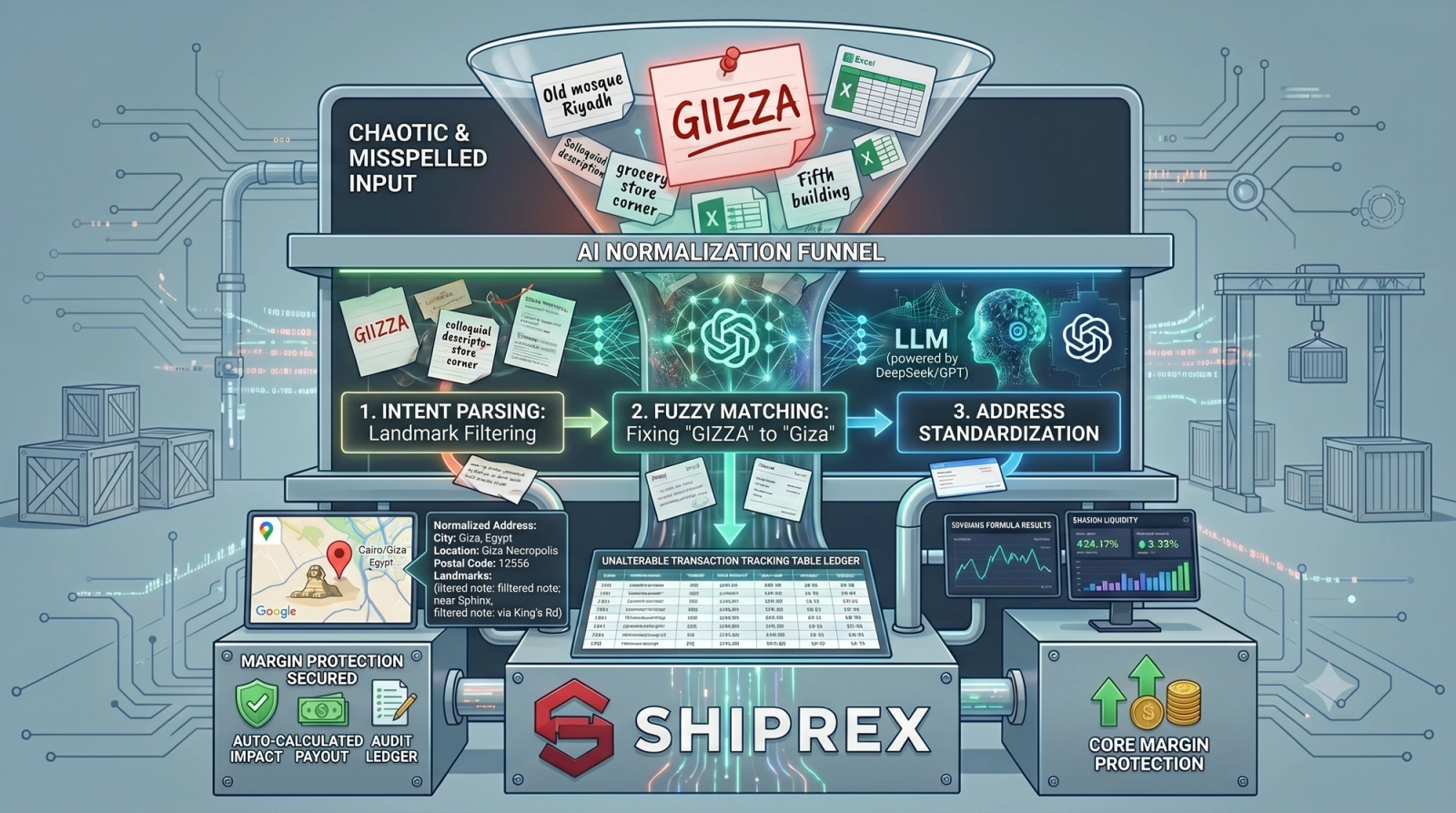
For multi-tenant shipping lines and high-volume fulfillment centers, scale is achieved through bulk automation. The entry point for this scale is typically a merchant importing thousands of delivery rows via an Excel or CSV file.
However, this entry point is also where operational efficiency frequently breaks down.
In emerging and regional e-commerce corridors—particularly across KSA, Egypt, and the GCC—addresses are rarely structured uniformly. A merchant's spreadsheet might list a city with varied phonetic spellings (e.g., "Riyadh", "Riyadh City", "Al-Riyadh", or "Riyad").
When a standard, non-intelligent shipping platform attempts to ingest this data, it faces a database conflict. Because the text string fails to perfectly match the hardcoded values inside the zone tables, the system either throws an import exception or places the package into an unassigned "unknown location" status pipeline.
The High Financial Toll of Fuzzy Address Strings
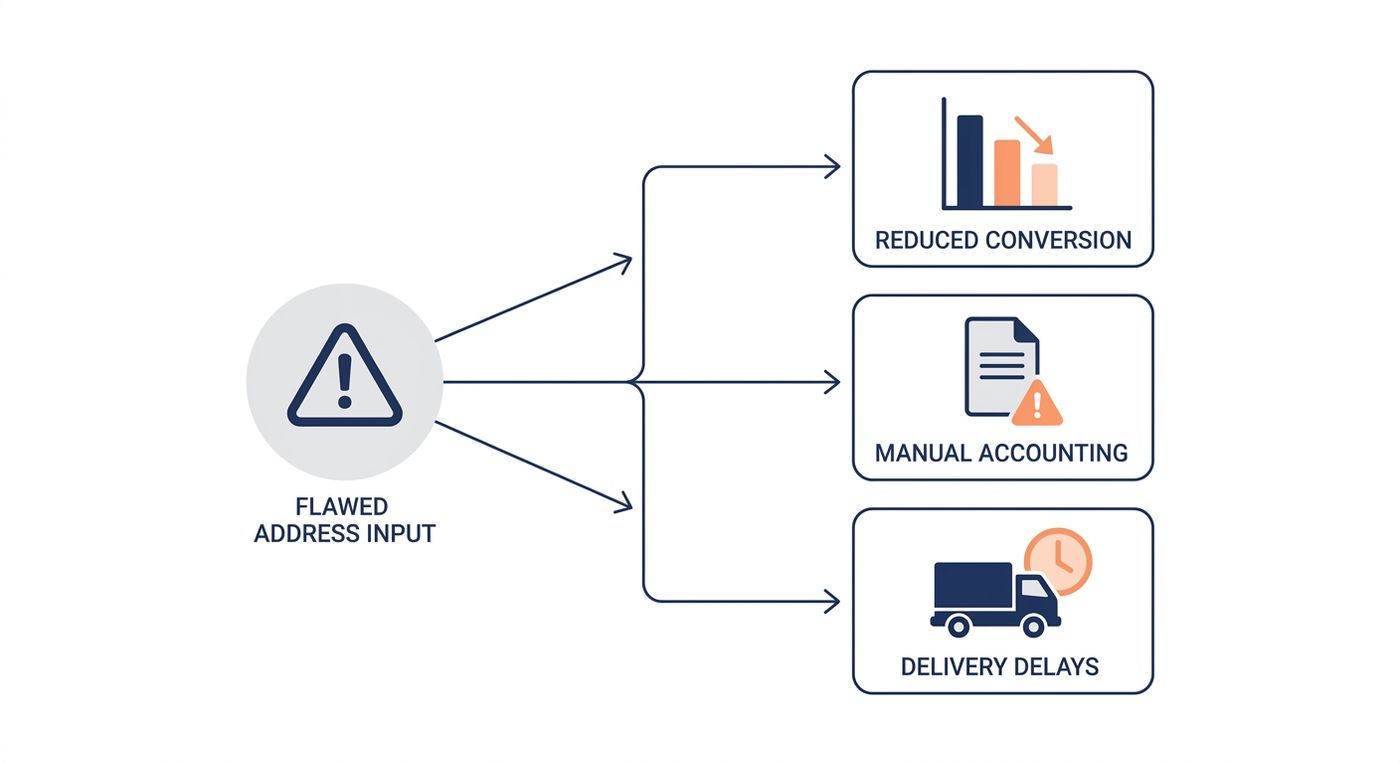
When bad location data slips past the ingestion gate, it creates a chain of costly operational bottlenecks downstream:
- Pricing Bleed: If an order bypasses the zone matching engine, it fails to trigger the zones_users matrix. The platform is forced to drop back to a basic generic pricing rule, often causing you to undercharge a client for a distant or difficult territory.
- Payout Inaccuracies: The system cannot resolve the proper zones_drivers calculation. Consequently, driver commission values must be evaluated and patched manually by accounting clerks before payouts can be cleared.
- Transit Delays: Packages are assigned to incorrect regional distribution hubs, adding unnecessary handling steps and causing delivery dates to slip.
Integrating Intelligent Normalization Fields
To eliminate this operational friction, advanced shipping enterprise resource planning (ERP) platforms integrate Large Language Models (LLMs) like DeepSeek or customized text-processing microservices directly into the core controllers, such as:
This integration changes how data string valuation functions during the bulk upload cycle:
Step 1: Text Sanitization and Extraction
When a raw address text block is parsed, the LLM-driven layer strips away secondary landmark descriptors and contextual noise (like phone numbers or customer delivery time instructions). It isolates the core regional naming components.
Step 2: Algorithmic Fuzzy Matching
The system checks the input string against a dynamic database table of alternative, historically generated geographical titles. If a clear match isn't found, the integrated model evaluates the text phonetically and semantically, identifying the correct intended zone with over 98% accuracy.
Step 3: Automated Price Matrix Resolution
The second the name is normalized to a valid system zone, the core database engine resolves the financial dependencies concurrently:
This automatic matching guarantees that your financial margins remain completely protected from user data entry mistakes before the package ever reaches a courier's hands.
Securing Operational Efficiency at the Data Gate
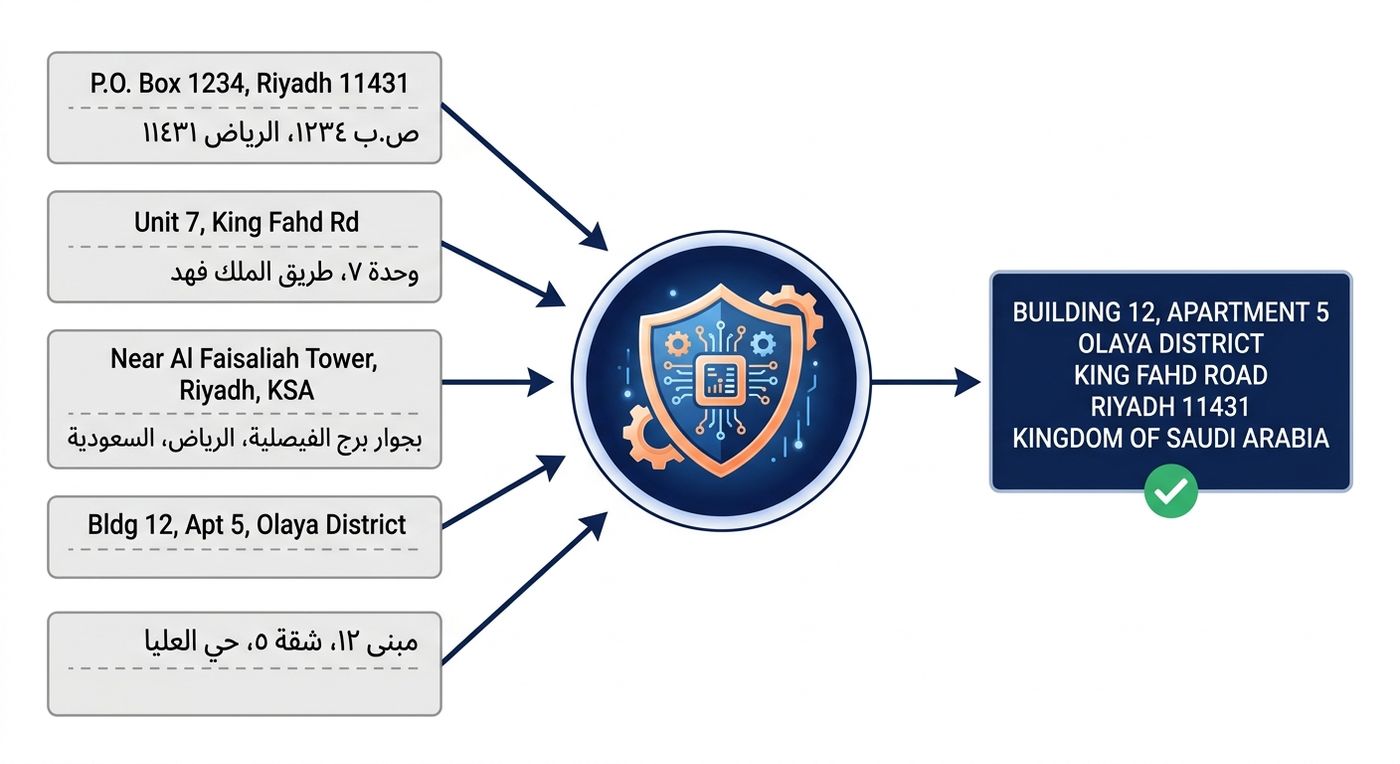
Deploying intelligent name and address normalization completely changes how your dispatch office handles bulk merchant accounts. In the fast-paced MENA logistics landscape, manual data entry and poorly formatted customer manifests are silent margin killers. Support teams stop wasting hours reviewing address rows, cross-referencing bilingual entries, or manually contacting clients to verify spelling variations.
By allowing an artificial intelligence layer to manage data parsing at the ingestion gate, shipping operations can handle significantly higher daily order volumes—speeding up processing times, stabilizing payout accuracy, and building an automated framework ready for regional scale.
The MENA Data Challenge: Transliteration and Varied Formats
Logistics in the MENA region faces a unique data hurdle: the constant interplay between Arabic and English scripts, combined with a lack of standardized postal codes in many expanding urban zones.
When bulk merchants upload their daily shipping manifests, your system is often flooded with inconsistent data points:
- Transliteration Discrepancies: A single neighborhood might be spelled "Al Barsha," "El Barsha," or "Al-Barsha." A recipient's name might appear as "Mohammad," "Muhammed," or "Mhd."
- Bilingual Mixing: Manifests often contain a mix of Arabic text, English text, and Franco-Arabic (Arabizi) shortcuts within the same address field.
- Vague Landmarks: Instead of a structured street address, delivery instructions often rely on landmarks (e.g., "Behind the old petrol station, near the mosque").
Shiprex’s intelligent data gate instantly parses these variations. By utilizing localized machine learning models trained on regional address patterns, the system automatically normalizes names, matches landmarks to precise geocoordinates, and standardizes spelling before the order ever reaches your routing engine.
Automating Bulk Merchant Ingestion
For shipping providers, B2B merchant retention depends on speed. When a major e-commerce merchant uploads a CSV or pushes 5,000 orders through your API, any data friction halts the entire pipeline.
- Zero-Delay Validation: Shiprex acts as an automated gatekeeper. The AI engine processes thousands of lines of data in seconds, flagging only the absolute anomalies for human intervention while automatically correcting 95% of common spelling and formatting errors.
- Reduced Customer Service Overhead: Your customer support agents no longer need to make tedious, expensive phone calls to consignees just to clarify an ambiguous street name or verify a family name for a Cash-on-Delivery (COD) shipment.
- Proactive Error Catching: If a phone number is missing a digit or a district does not match the specified city, the system flags it at the moment of ingestion, prompting the merchant to correct it before the label is printed.
Direct Impact on Bottom-Line Metrics
Clean data at the ingestion gate has a compounding positive effect across your entire operational workflow:
- Improved First-Attempt Delivery Rates (FADR): When couriers have clean, normalized names and verified neighborhood data, they spend less time searching for locations. This directly lowers fuel costs and minimizes expensive second- and third-attempt deliveries.
- Accelerated COD Payout Reconciliation: In the MENA region, Cash on Delivery remains a dominant payment method. Accurate name and account normalization ensures that delivery confirmations map perfectly to your financial ledgers, eliminating disputes with merchants and stabilizing your weekly payout cycles.
- Seamless Regional Scaling: As your business expands from Dubai to Riyadh or Cairo, your operations do not require a proportional increase in data-entry staff. The intelligent data gate scales horizontally, absorbing localized dialect variations and address styles without sacrificing dispatch speed.