Beyond Geocoding: How LLMs Convert Messy Text Addresses into Clean Logistics Data
Standard map APIs fail when delivery addresses are poorly formatted. Discover how Large Language Models parse chaotic customer text inputs, map them to hierarchical pricing zones, and protect your 3PL profit margins.
By Islam Baraka
The last mile is notoriously the most expensive and inefficient part of the supply chain. Yet, a massive percentage of last-mile failures don't happen on the road—they happen at the data entry level.
When e-commerce merchants upload bulk Excel manifests containing misspelled cities, missing street names, or highly colloquial descriptions (e.g., "Fifth building behind the old mosque, near the grocery store, Riyadh"), traditional geocoding engines break down. The result? Package delivery failure, wasted driver fuel, and a bottlenecked customer support desk.
The Failure of Traditional Geocoding
Most standard shipping ERP software relies strictly on rigid database matching or standard map APIs. If a string does not exactly match a hardcoded city or neighborhood table, the system either rejects the order or throws it into an expensive, manually handled "unknown location" bin.
How Large Language Models Step In
Modern, next-generation logistics software uses an event-driven framework integrated with specialized LLMs (like DeepSeek or GPT models) to treat address fields as conversational data rather than plain database strings.
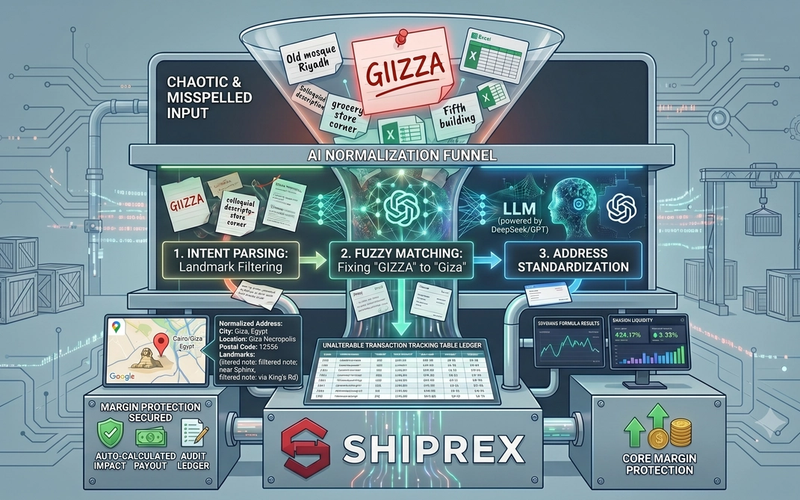
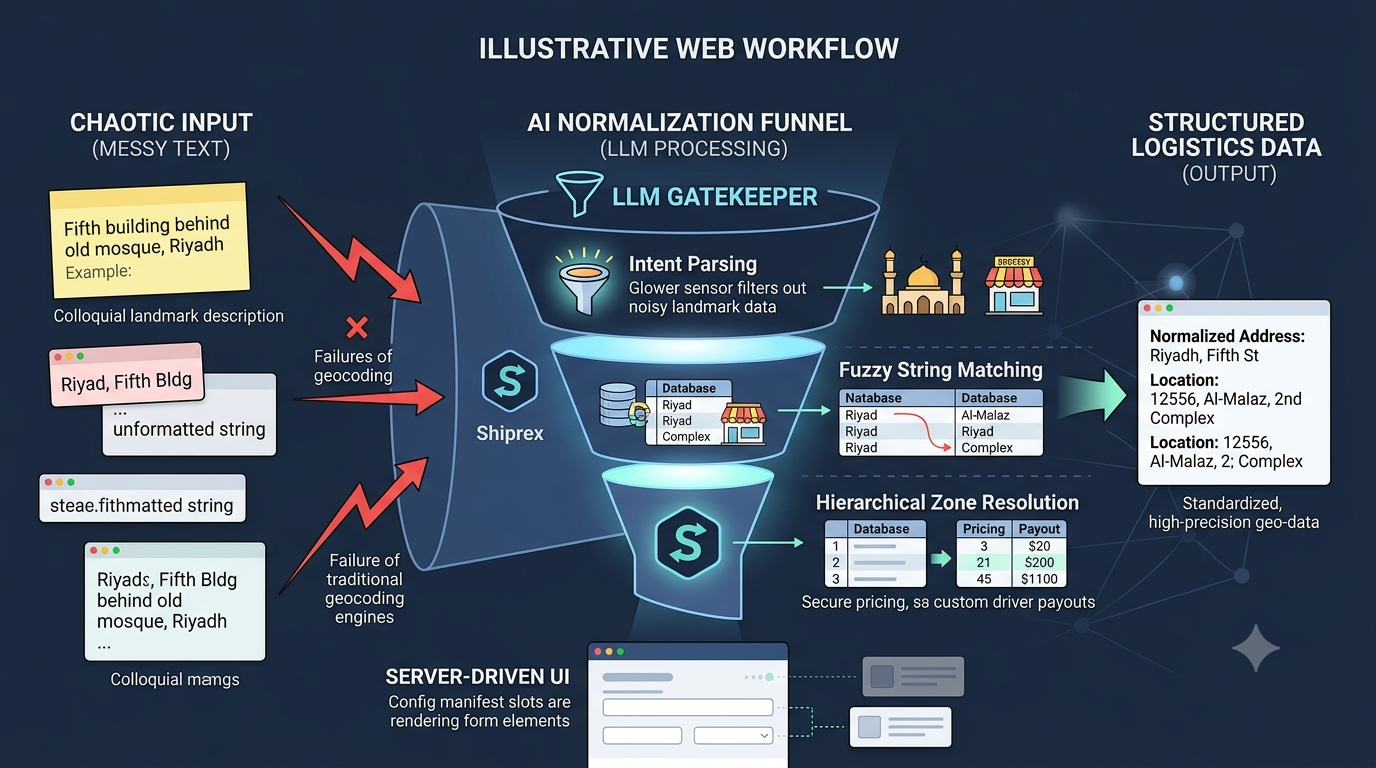
When a chaotic address string hits the engine, the AI normalization layer performs three distinct steps in milliseconds:
- Intent Parsing: It extracts the core geographical intent, filtering out descriptive noise like landmarks or custom notes.
- Fuzzy String Matching: It automatically generates alternative structural names for known geographical zones, mapping variations to a single uniform database record.
- Hierarchical Zone Resolution: Once resolved, the system dynamically pushes the order into a nested parent/child zone configuration, automatically applying customer-specific pricing structures and custom driver payouts.
By letting an AI layer act as the database gatekeeper, shipping companies can slash manual dispatch corrections by over 80%, reduce reverse logistics losses, and scale their bulk spreadsheet imports effortlessly.