Multi-Layered Zone Pricing: How Enterprise ERPs Matrix Shipping Fees, Merchant Contracts, and Driver Payouts
Running a profitable delivery network requires dynamic pricing rules. Discover how a hierarchical zone tree combined with custom per-merchant and per-driver overrides automates margin protection at order creation.
By Islam Baraka
In the third-party logistics (3PL) industry, pricing is rarely uniform. A rigid system that only allows you to charge a flat rate per city is an architectural bottleneck that actively drains your profits.
Consider this standard operational reality: an enterprise e-commerce merchant moving 5,000 packages a month will demand highly aggressive, discounted shipping rates to regional hubs. At the same time, a boutique social-commerce seller dropping 20 packages a month must be charged standard retail delivery fees for those exact same locations.
Compounding this complexity is the driver variable. Delivering to a dense, urban high-rise sector requires a completely different payout incentive for your couriers than dispatching to a remote, low-density suburban perimeter.
Trying to manage these intersecting financial rules across spreadsheets or basic software platforms results in severe billing leakage, inaccurate driver wallets, and constant accounting disputes.
To scale safely, an enterprise shipping platform must deploy a hierarchical, multi-layered pricing resolution matrix that evaluates and locks in financial metrics the exact millisecond an order is created.

The Failure of Flat Location Tables
Legacy ERPs and home-grown logistics systems almost always make the same foundational architectural mistake: they treat geographical locations as a flat, two-dimensional list. In these systems, a location is simply a row in a database—a city name tied directly to a single, static price tag.
While this simplistic model works when you are managing ten drivers in a single city, it utterly collapses under the weight of modern B2B logistics. In the MENA region, where address systems lack standardization, cross-border GCC trade is highly dynamic, and last-mile delivery demands extreme precision, flat location tables become a massive operational bottleneck.
The Multiplier Effect: Database Bloat and Query Latency
The primary failure of a flat database design is its inability to handle custom client contracts without endless data duplication.
Consider a mid-sized 3PL or courier enterprise in the MENA region:
- The Baseline: You service 50 delivery zones (covering major hubs and remote areas across Saudi Arabia, the UAE, and Egypt).
- The Client Base: You manage 500 active merchants, each with negotiated, bespoke rate cards based on their volume, industry, and average package weight.
- The Weight Slabs: Each contract has at least 5 weight brackets (e.g., 0-5kg, 5-10kg, etc.).
In a flat database model, you cannot inherit or dynamically calculate rates. Instead, developers must generate and store hardcoded rows for every single permutation. The math is punishing:
$$\text{500 merchants} \times \text{50 zones} \times \text{5 weight slabs} = \text{125,000 individual database rows}$$
If you introduce cash-on-delivery (COD) fees, premium same-day delivery options, or holiday surcharges, that number easily swells into millions of rows.
When your dispatchers or client portals attempt to calculate a shipping quote during peak shopping seasons like White Friday, the ERP must scan through millions of redundant rows. This causes severe database latency, slows down automated API booking integrations, and leads to timeout errors at checkout for your e-commerce clients.
The MENA Address Reality: Nested Hierarchies vs. Static Rows
Flat tables assume that geography is clean, linear, and universally structured. In reality, address routing in the MENA region is highly nested and fluid. A delivery destination is not just "Riyadh"; it is Saudi Arabia (Country) $\rightarrow$ Central Region (Province) $\rightarrow$ Riyadh (City) $\rightarrow$ Al-Malaz (District) $\rightarrow$ Geofenced Zone B (Operational Sector).
When an ERP relies on a flat list, it cannot understand these hierarchical relationships. This architectural blind spot causes major operational failures:
- No Regional Inheritance: If you want to apply a flat 5% customs clearance surcharge to all deliveries entering the Eastern Province of KSA, a flat system cannot apply this rule globally. Operators must manually update every single city and district row associated with that province.
- Geofencing Incompatibility: Modern last-mile operations rely on polygon geofences to bypass unreliable postal codes. Flat tables cannot map a dynamic GPS coordinate to a pricing tier without complex, slow, and error-prone translation layers.
The Maintenance Trap: Surcharges and Tariff Leakage
The most severe consequence of flat location tables is "tariff leakage"—unbilled or incorrectly billed shipping costs that directly erode your profit margins.
Because flat tables require hardcoded entries, updating baseline operational costs is a manual nightmare. For instance, when regional fuel prices fluctuate or cross-border toll fees change at the King Fahd Causeway, your finance team cannot simply adjust a single master variable. They must run massive, risky SQL update scripts across millions of rows of merchant contract data.
This manual overhead inevitably leads to errors:
- Under-billing: Certain merchant contracts miss the update, causing you to honor outdated, unprofitable rates while your actual fuel costs rise.
- Over-billing: Clients are accidentally charged incorrect rates, leading to billing disputes, delayed payments, and damaged B2B relationships.
- Operational Paralysis: Because rate updates are so labor-intensive, operations managers delay adjusting their pricing to match market realities, absorbing losses in the interim.
The Mechanics of Hierarchical Matrix Resolution
An advanced logistics engine resolves this architectural problem by dividing spatial locations from contract overrides, stacking them into three distinct, intelligent calculation layers:
Layer 1: The Hierarchical Zone Tree (Base Structure)
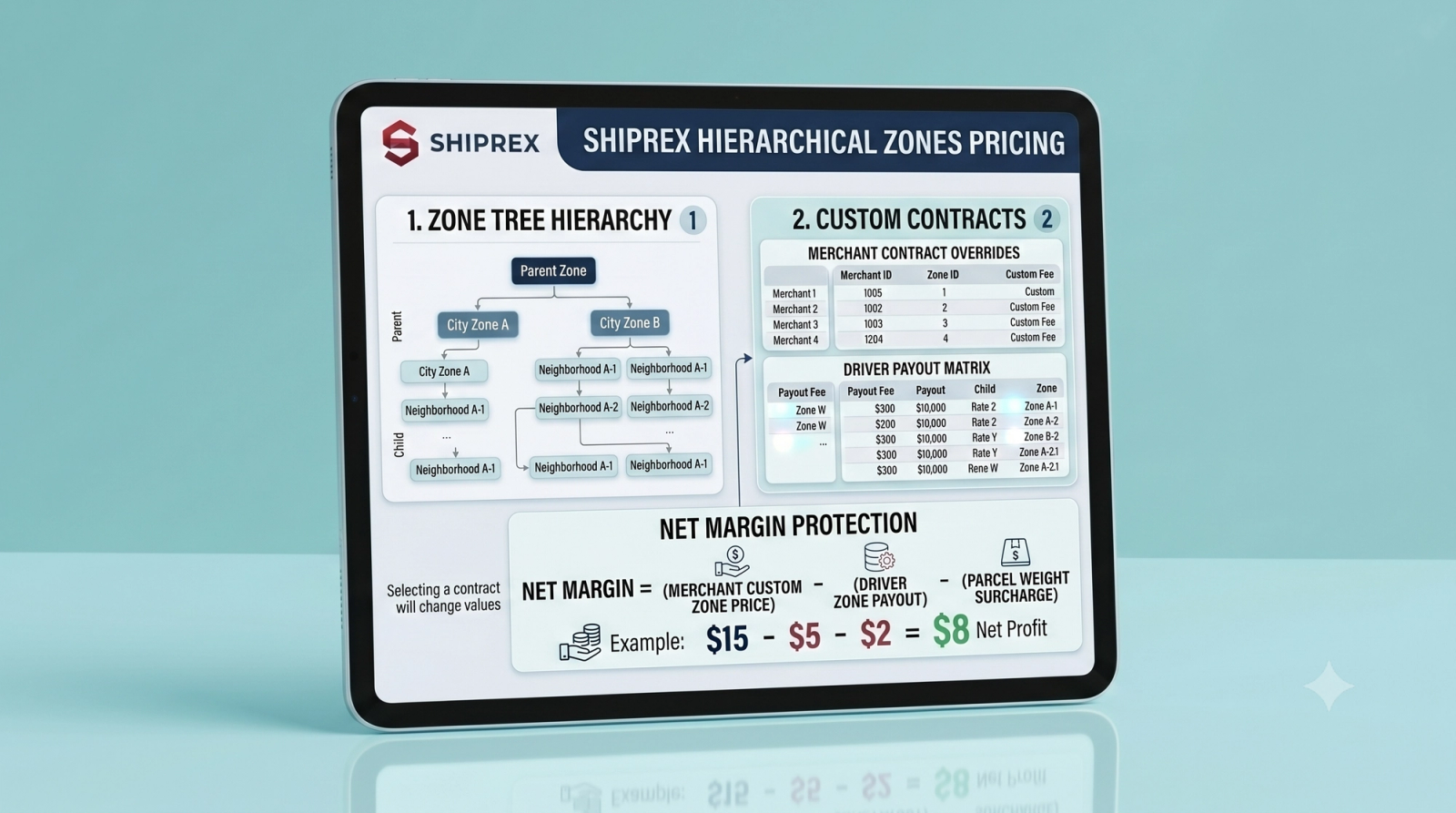
Instead of flat lines, geographical destinations are organized using an underlying database tree structure (Parent/Child relationships).
For instance, a broad territory like "Western Region" serves as a parent zone with a generic base fee. Nested underneath it are child nodes like "Jeddah Central" or "Mecca Suburbs," which inherit their parent's pricing properties unless given a specific local micro-price tag.
This tree setup allows you to manage thousands of areas under unified umbrella profiles while maintaining hyper-local precision.
Layer 2: Per-Merchant Contract Overrides (zones_users)
To handle customized B2B accounts, the platform maps a separate relationship table linking specific merchant IDs to targeted zones. When an order manifest is processed, the core database engine executes a specific resolution script inside its data tables:
If a custom contract row exists for that specific client and zone, the platform overrides the generic baseline fee instantly. This enables you to run hundreds of varied merchant contracts concurrently on the same regional grid without data collision.
Layer 3: Per-Driver Payout Overrides (zones_drivers)
The final layer protects your courier operations. Just as merchants require custom billing, delivery drivers require localized commission models to stay motivated.
The system deploys a mirrored payout matrix (zones_drivers). This enables fleet supervisors to set custom delivery payouts per courier per zone.
Whether you pay an internal employee a fixed base rate or reward an independent contractor with a premium multi-zone payout for a remote run, the engine locks the exact payout calculation directly into the driver's digital ledger wallet at the moment of dispatch.
The Financial Math of Core Margin Protection
By enforcing this layered validation flow inside a single database transaction, the platform auto-calculates and secures your operational net profit before a package ever leaves your sort center:
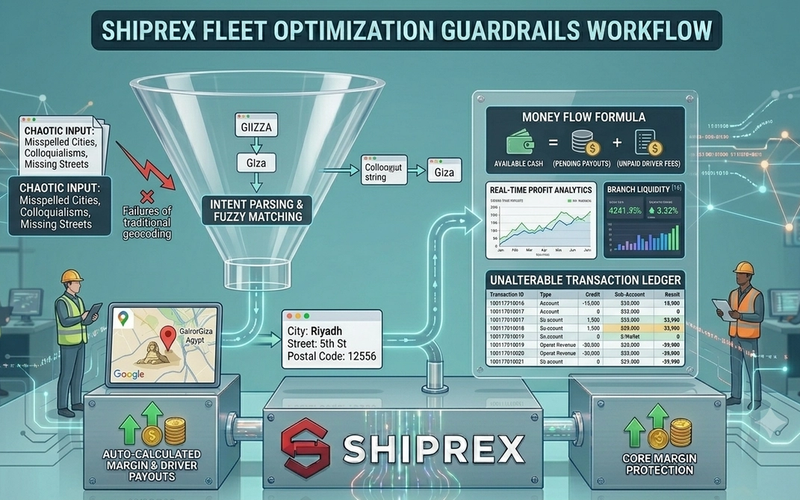
If an order comes in with an unmapped address or a misspelled city string, an integrated AI layer normalizes the naming text, or automatically drops the record back into a safely configured "Default Fallback Zone" price code—ensuring your system never processes an accidental free delivery.
Automating Business Growth
Transitioning to a multi-layered matrix architecture completely transforms your accounting and sales operations. Your commercial team can confidently negotiate complex, high-volume merchant contracts with tiered pricing tiers, knowing the system will enforce the rules flawlessly.
By grounding your billing logic in hierarchical structures and automated overrides, you eliminate manual auditing, stop margin leakage, and build a highly scalable shipping operation ready to dominate competitive logistics markets.