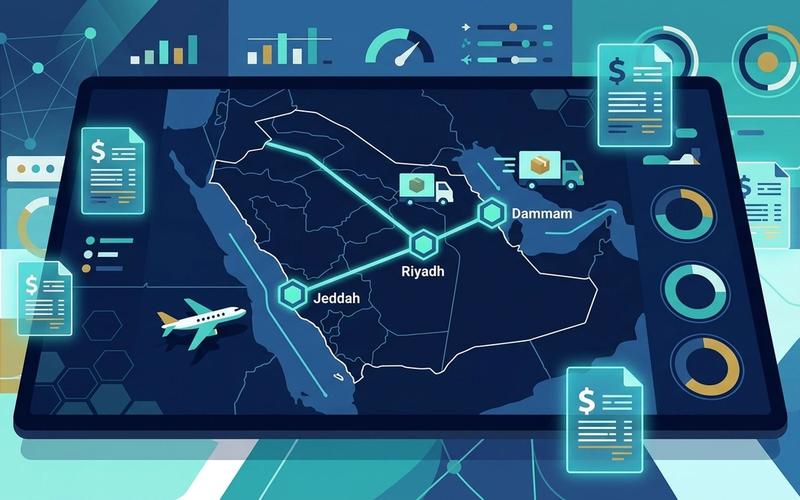
Multi-Currency Branching: Streamlining MENA Logistics Finances
Discover how Shiprex's Multi-Branch ERP consolidates cross-border financial records, converting volatile currencies like EGP into a single source of truth.
By Islam Baraka

The Cross-Border Expansion Challenge in MENA
For logistics and 3PL companies in the MENA region, scaling across borders is the ultimate growth milestone. However, operating simultaneously in Cairo and Riyadh introduces complex operational and financial challenges. While the Saudi market offers high-value transactions denominated in stable Saudi Riyals (SAR), the Egyptian market—though massive in volume—operates in Egyptian Pounds (EGP), a currency subject to significant macroeconomic fluctuations.
Without a centralized system, logistics providers run into a fragmented operational model. Cairo branches manage their billing, driver payouts, and cash-on-delivery (COD) in EGP, while the Riyadh headquarters or regional branches operate in SAR or USD. When consolidation time comes, finance teams spend days manually reconciling spreadsheets, trying to determine the actual profitability of the business amidst shifting exchange rates.
This is where a multi-currency logistics ERP steps in to establish a single source of financial truth.
---
The Core Issue: Fragmented Ledgers vs. Financial Truth
When a shipping company expands, it often treats its new regional branch as a separate entity with its own independent software or isolated database. This creates several critical issues:
- Lagging Exchange Rates: Manual conversions do not account for daily (or hourly) fluctuations in the EGP, leading to inaccurate pricing and lost margins.
- Dispersed Bank Ledgers: Managing separate bank accounts in different countries without a unified ledger makes it impossible to view real-time cash flow.
- Compliance Hurdles: The company must comply with different local tax authorities simultaneously, such as the ZATCA e-invoicing requirements in Saudi Arabia and the ETA e-invoicing system in Egypt.
To scale efficiently, logistics leaders need more than just separate accounting software for each office. They need a unified system that automatically converts all regional branch transactions into a main corporate reporting currency while maintaining local sub-ledgers.
---
Solving the Equation with Shiprex Multi-Branch ERP
Shiprex’s Multi-Branch plugin is engineered specifically to solve regional fragmentation. Instead of maintaining disconnected systems, the platform provides a unified structure where all branches operate under one digital roof, yet retain localized accounting parameters.
1. Unified Ledger with Automatic Currency Conversion
Whether your Cairo branch is processing cash-on-delivery in EGP or your Riyadh branch is invoicing corporate clients in SAR, Shiprex converts all transactions into your corporate base currency (e.g., USD or SAR) in real-time. This provides executives with an instantaneous, accurate view of total regional revenue and profitability without manual compilation.
2. Guarding Against EGP Volatility
With the fluctuation of the EGP, static pricing can erode margins overnight. Shiprex integrates with live currency exchange APIs to ensure that cross-border shipping rates, customs clearance fees, and operational costs are calculated using up-to-the-minute conversion rates. This dynamic pricing model protects your bottom line from sudden currency devaluations.
3. Localized Compliance Built-In
Operating in multiple countries means adhering to distinct regulatory frameworks. The Shiprex multi-branch architecture allows the Riyadh branch to generate fully compliant ZATCA Phase 2 e-invoices, while the Cairo branch seamlessly integrates with the Egyptian Tax Authority (ETA) portal—all managed from a single administrative dashboard.
---
Achieving Operational Harmony
By leveraging the Shiprex Multi-Branch plugin, MENA logistics companies shift from reactive bookkeeping to proactive financial management.
- For Operations Managers: Dispatching and tracking cross-border shipments becomes seamless, with visibility over which branch owns the asset and which branch handles the delivery.
- For CFOs: Consolidating regional performance, reviewing inter-company balances, and assessing net margins takes minutes instead of weeks.
- For Engineers: Maintaining a single API integration for the entire regional footprint reduces technical debt and simplifies system maintenance.
Scaling from Egypt to the Gulf should not mean doubling your administrative overhead. With a dedicated multi-currency logistics ERP, your business can confidently capture regional market share while keeping its financial records anchored to a single, unshakeable source of truth.