Beyond Shipping Fees: Why Your Logistics Software Needs a Built-in General Ledger
Many 3PL firms experience cash flow crises despite high delivery volumes. Learn how a built-in General Ledger and the Money Flow formula prevent cash leaks and secure real-time liquidity
By Islam Baraka
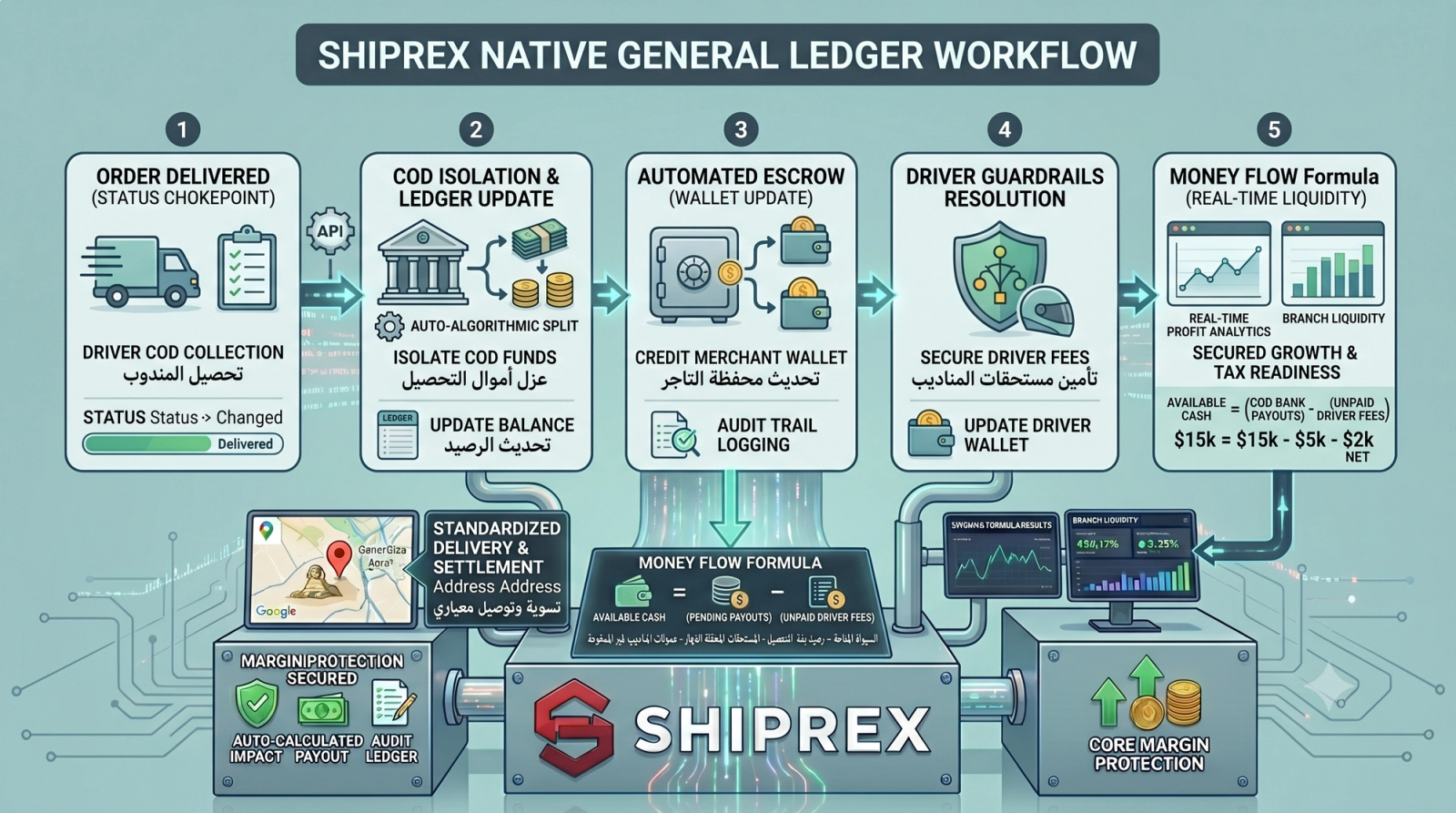
For third-party logistics (3PL) providers and courier operations, handling a package is only half the job. The real friction lies in handling the money.
When your fleet processes thousands of Cash on Delivery (COD) orders daily, your corporate bank accounts quickly fill up with capital that does not actually belong to you. It belongs to your merchants. Without an underlying accounting engine, separating your true operating revenue from pending client payouts is a logistical nightmare that frequently triggers unexpected cash flow crunch points.
The Danger of the "Total Cash" Illusion
Many independent delivery businesses manage their cash flow by simply checking their primary bank balances. This is a dangerous mistake. At any given moment, the cash sitting in your bank is a volatile mix of collected COD values, unliquidated courier fees, and pending driver commissions.
If you use that central capital pool to pay for overhead expenses, vehicle maintenance, or scaling costs without real-time ledger division, you are essentially borrowing from your clients’ revenue—a cycle that eventually triggers operational stalls.
Mastering the Money Flow Formula
To remain securely liquid, enterprise shipping systems drop standard tracking metrics in favor of a strict financial safety formula. Modern logistics platforms use an automated dashboard matrix to calculate your exact financial standing:
$$\text{Available Cash} = \text{COD Bank Balance} - \text{Pending Payouts} - \text{Unpaid Driver Fees}$$
Let's break down why tracking this formula inside a single database ledger matters:
- COD Isolation: It instantly isolates cash collected at the doorstep from your corporate operational income.
- Automated Escrow: When a status transitions to "Delivered" or "Collected" via the unified status choke point, the core database immediately updates the specific merchant's sub-account wallet while logging the absolute transaction trail in the balance ledger.
- Driver Guardrails: Driver zone payout matrices are locked in at order creation, ensuring that driver commissions are accounted for before any merchant payout file is generated.
Securing Growth Through Financial Transparency
By moving away from external spreadsheets and implementing a software architecture with a native General Ledger, 3PL providers gain full visibility over their cash health. Accountants get dedicated workspaces to track daily bank activity, and operators can roll out self-service vendor wallets with clear negative-balance thresholds to keep the business completely audit-ready and immune to cash leaks.