The Architecture of Extensibility: Why We Built a "WordPress for Logistics"
Rigid tech stacks break when developers are forced to write custom code for every single business requirement. Explore how a global settings registry, decoupling filters, and unified status hooks create a bulletproof framework for rapid logistics deployment.
By Islam Baraka
When software engineering teams build software applications for logistics companies, they quickly run into a major issue: no two delivery companies operate the exact same way.
One logistics client might require complex multi-branch currency splits, while another might need specialized automated SMS notification sequences or unique partial-delivery accounting trails.
In traditional enterprise development, trying to accommodate all of these varied operational paths results in a massive, fragile code codebase. Developers end up scattering hardcoded if/else statements across the application. Eventually, adding a feature for one customer inadvertently breaks the core accounting calculations or order routing pipelines for everyone else.
To solve this core scalability issue, the backend must move past static, hardcoded application design and adopt a completely modular, event-driven hook architecture—functioning essentially like a mini-WordPress, but optimized for the strict transactional demands of global shipping.
The Strategy Behind Modularity
The core architectural philosophy is simple: Core code remains immutable; custom behaviors belong strictly inside plugins.
By ensuring that core controllers and table components never contain client-specific business rules, the engineering team can roll out core performance improvements and database optimizations without breaking user customizations.
The Three Engineering Pillars of Extensible Logistics Software
Building a system that seamlessly handles 28+ separate plugin feature modules requires decoupling application states using three primary design mechanisms:
1. A Unified Settings Engine
Instead of setting up static configuration columns across separate database tables, the core framework relies on a global, keys-based options registry. Leveraging fast runtime lookups, developers can query system flags across any layout or action file:
// Example of checking global settings dynamically
if (get_option_value('enable_negative_stock_guard')) {
    // Execute safety check logic here
}
This dynamic structure allows features to be toggled on or off instantly across specific merchant profiles or branches without altering database table definitions.
2. The Single Status Choke Point
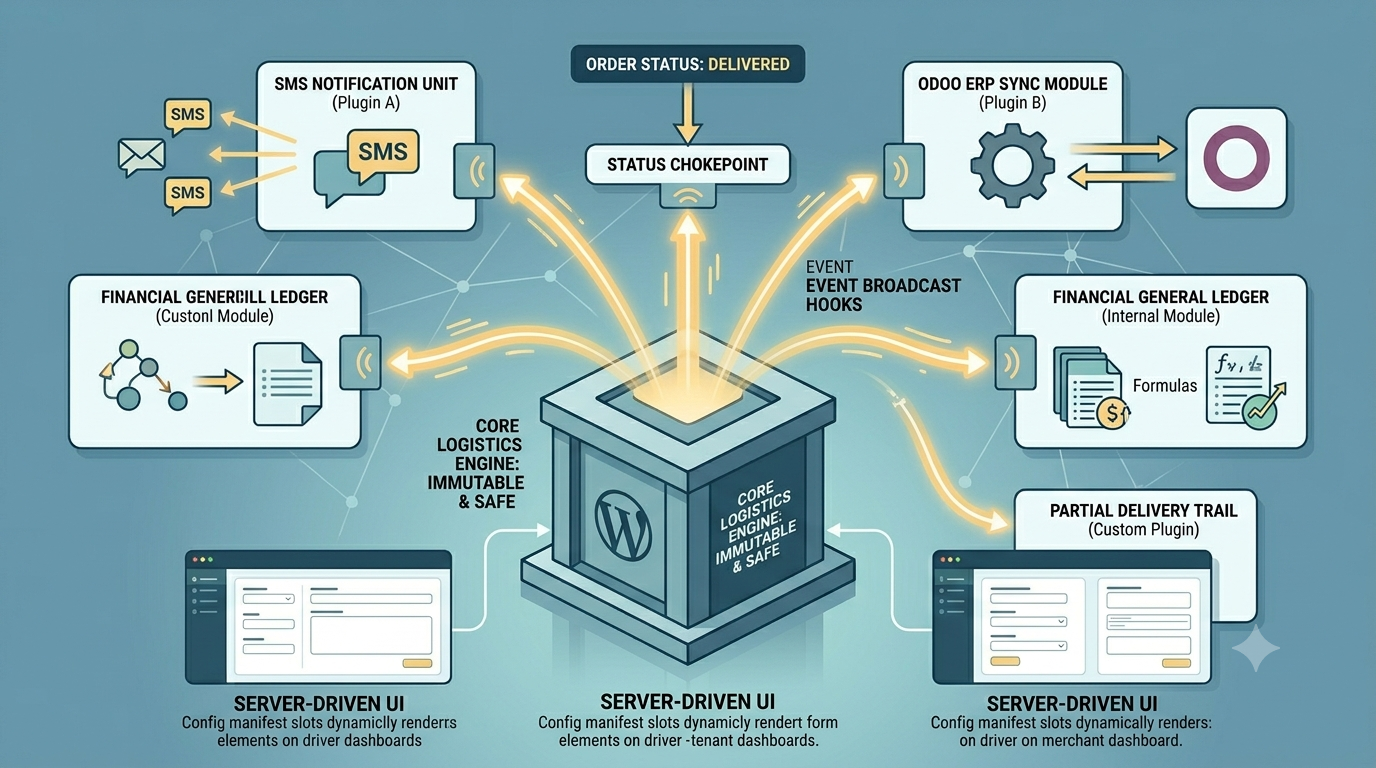
In logistics tech, an order changing its status is a critical event. When a package transitions from On route to Delivered, multiple downstream systems must react concurrently: cash balances must update, SMS notifications must fire, vendor wallets must be credited, and inventory records must be logged.
If these triggers are written manually into multiple controller files, bugs will occur. The solution is routing every single status modification through a unified database function, such as:
OrdersTable::actionUpdates()This single entry point automatically dispatches a system-wide event listener signal:
Model.UpdatedOrderStateAny active plugin—whether it's an automated SMS gateway, a third-party ERP connector like Odoo, or an internal general ledger module—simply listens for this specific broadcast and executes its tasks independently. If a plugin fails or is disabled, the core transaction remains intact.
3. Decoupled Form and Config Registries (Server-Driven UI)
To maintain an API-first framework alongside legacy web layouts, form configurations, data tables, and user actions are resolved dynamically from the backend registries rather than hardcoded in front-end frameworks.
When a plugin is enabled, it registers its custom components, meta-fields, and button triggers into manifest slots. The front-end reads these configuration endpoints and renders the correct form elements instantly. This enables the UI to adapt dynamically on the fly without forcing developers to deploy front-end builds to remote driver portals or merchant dashboards.
Empowering Engineering Teams to Scale
Moving to a decoupled, event-driven plug-and-play architecture completely changes how development teams scale software systems. Engineers stop spending time debugging regressions or writing custom code patches for individual clients. Instead, they focus on building high-value, performant microservices and specialized feature blocks.
This architectural approach allows logistics systems to maintain absolute reliability at the core while providing the ultimate flexibility to adapt to any market condition or enterprise workflow worldwide.